Subsequent to my last trip to Cambodia which is more of a lonely trip, this time our trip was to Sandakan, Sabah. As it was school holidays and my daughters wanted a kind of adventure trip (also with budget and duration constraints), we choose to visit a part of Sabah. I have already explored a 100 KM surroundings of Kota Kinablu, so this time visited around the second big city of Sabah. There is nothing much to see in the Sandakan city itself but its neighboring villages provide many natural attractions. with 5 nights at hand, we split it among Sepilok, Sandakan and Kinabantan. Reaching Sandakan is also not an easy one (well for family with young children). It doesn't have an international connection and we have to transfer either at Kuala Lumpur or Kota Kinabalu. We booked the entire trip (SG - KL - SDN and back) with AirAsia and the waiting time at KL was patient-testing.
This is also my first trip (family and alone) where we have rented a car from landing until departing. With Hertz giving a heavy discounted price, happy to drive a 1.6 cc sedan. We started at Singapore by 9 in the morning to KL LCCT. There was a three hours wait for us to board our next flight to Sandakan. The LCCT in KL is a very busy airport with so many domestic and international departures dominated by AirAsia. We had all the time to fill ourselves with McD, juices and for me to get a SIM card and a data plan. It just took 5 MYR for a SIM, 5 MYR voice top-up and 20 MYR data plan (4 GB / 7 days) which is enough to cover our entire trip for voice and data. At about 1pm, we started to Sandakan and reached there by about 4pm. being a small airport with only domestic flights, Sandakan airport is quiet. Took over my car from Hertz and headed straight to Sepilok. We organized in such a way that we stay in Sandakan on Saturday and Sunday. So, our first stop was Sepilok where we booked a big chalet for our family in a forest lodge very near to the orang-kutan rehab centre. Sepilok is at about 20 KM away from Sandakan on the way to Kota kinabalu. The highway from Sandakan to Kota kinabalu itself is just a two way (one lane each direction), but as I have experienced such roads in Kota kinabalu, came no surprise. Once we entered the lodge (Sepilok forest edge lodge) in the middle of the forest setting, the family instantly liked its surroundings. Our allotted chalet was even more serene with a huge room and a balcony overlooking a mini-forest. As it was already over 6pm, we quietly had our dinner and rested. It was a long day just flying and transiting and we have a big day ahead trying to venture into some of the forest walks.
A view from our chalet
Friday, August 10, 2012
Saturday, July 7, 2012
Travel 010 : Cambodia : 25 Dec : Banteay Samre and Pre Rup
Coming back into the inner circle, my next stop was Banteay Samre.
The temple has multiple layers and each layer has four entrances. Above most of the entrance gates, many Hindu epics scenes are sculptured. One here is a battle scene
The last stop for the Chrismas was Pre Rup. Here I watched the sun set from the peak of this pyramid structure. Chrismas day ended with Pre Rup.
The temple has multiple layers and each layer has four entrances. Above most of the entrance gates, many Hindu epics scenes are sculptured. One here is a battle scene
The last stop for the Chrismas was Pre Rup. Here I watched the sun set from the peak of this pyramid structure. Chrismas day ended with Pre Rup.
Sunday, July 1, 2012
Travel 009 : Cambodia : 25 Dec : Banteay Srei
Next stop was Banteay Srei temple. I crossed this temple on my way to Kbal Spean at about 9am and I saw many tourist buses. But, when I came back at about 11.30, there is very little crowd in this temple. This is the first temple I saw on my trip that is different from other temples in many ways. The area is small, the actual buildings so tiny that a normal man cannot go into the individual sanctuaries. But, most of the sculptures carved here are very clear and very striking. As each is carved on a small wall (compared to the Angkor Wat bas-reliefs), it is very detailed and clear.
One with Indiran on his vahana (Vehicle) Ayravadham (three faced elephant)
One with the Narashimha avatar of Vishnu (lion face and human body)
One with Shiva and Parvathi on the Nandhi.
One with Krishna's kalinga nardhanam (dancing on the snake kalinga)
One with the Natarajar (the dancing form of Shiva)
One with Ravana shaking the mount kailash with Shiva and Parvathi on top of it.
It is a good blend of various form of both Shiva and Vishnu.
One with Indiran on his vahana (Vehicle) Ayravadham (three faced elephant)
One with the Narashimha avatar of Vishnu (lion face and human body)
One with Shiva and Parvathi on the Nandhi.
One with Krishna's kalinga nardhanam (dancing on the snake kalinga)
One with the Natarajar (the dancing form of Shiva)
One with Ravana shaking the mount kailash with Shiva and Parvathi on top of it.
It is a good blend of various form of both Shiva and Vishnu.
Saturday, June 23, 2012
Travel 008 : Cambodia : 25 Dec : Kbal Spean
It is Christmas day. I could able to wake up almost within my schedule (well still 7.30am). after breakfast, I made to my tuk-tuk at about 9.30am. Today, I want to start with possibly a most remote of the attractions here and also as a change to all the temples and ruins, it is a small mountain and waterfall. Kbal Spean (River of thousand lingas) is located about 50 KM from Siam Reap. As usual I discussed a rough itinerary for today with the tuk-tuk guy and he was hesitantly told that as this is of longer distance, his day charge will be 25 dollars instead of 15 dollars. After two days of spending time with him, I am fine with this and started. After more than an hour and the usual pass-punching along the way, reached Kbal Spean and started walking upwards. From the place where tuk-tuk dropped me to the river that I wanted to visit, it is 1.5 KM uphill and the distance is clearly displayed every hundred meters. It is a mix of plain paths, rocky climbing, one wooden staircase where the rocks are not safe. Though it is uphill, I guess an eight year old can go all the way up and down with a little encouragement. It took me slightly less than an hour to reach up with some breaks in between for water and snacks.
The first place I stopped (for sight-seeing) is the natural stone bridge. The water stream falls down at the small rock at one side of the bridge and flow below the bridge. On the other side of the bridge, we cannot see any water stream as the water runs below the rocks and appear only a bit far. At the small rack where the water stream is falling, there are sculptures of Vishnu in the lying down pose with Lakshmi and Brahma. Also found are Shiva and Parvathi on the Nandi.
Many parts of the remaining rocks are carved in such a way that they appear like a group of Lingas (and so the name River of thousand Lingas).
If one doesn't read any kind of guidebook about this place, it is possible that they just see this place and start walking downwards. We can walk a bit along the downstream and so I did. Further down, we can see two more Vishnu carvings.
Walking beyond that, at a place where the water is very shallow, we can see the actual rocks below the water stream. There is the main Shivalinga carving and hundreds of Lingas at the river bed below the stream.
Further down, there is a nice little waterfall which pretty much marks the end of what I have to see. From the waterfalls, I reached back to the main path along another loop (not by coming back upstream to the stone bridge) and descend downwards back to my tuk-tuk. Though the up-climbing is a bid humid and sweaty, at the top, it is cool and windy. I can really feel a difference as I was visiting temple after temple for the past two days.
The first place I stopped (for sight-seeing) is the natural stone bridge. The water stream falls down at the small rock at one side of the bridge and flow below the bridge. On the other side of the bridge, we cannot see any water stream as the water runs below the rocks and appear only a bit far. At the small rack where the water stream is falling, there are sculptures of Vishnu in the lying down pose with Lakshmi and Brahma. Also found are Shiva and Parvathi on the Nandi.
Many parts of the remaining rocks are carved in such a way that they appear like a group of Lingas (and so the name River of thousand Lingas).
If one doesn't read any kind of guidebook about this place, it is possible that they just see this place and start walking downwards. We can walk a bit along the downstream and so I did. Further down, we can see two more Vishnu carvings.
Walking beyond that, at a place where the water is very shallow, we can see the actual rocks below the water stream. There is the main Shivalinga carving and hundreds of Lingas at the river bed below the stream.
Further down, there is a nice little waterfall which pretty much marks the end of what I have to see. From the waterfalls, I reached back to the main path along another loop (not by coming back upstream to the stone bridge) and descend downwards back to my tuk-tuk. Though the up-climbing is a bid humid and sweaty, at the top, it is cool and windy. I can really feel a difference as I was visiting temple after temple for the past two days.
Saturday, April 14, 2012
Travel 007 : Cambodia : 24 Dec : Ta Phrom
The last stop I had today is at Ta Prohm. This is probably one of the most famous sites, after Angkor Wat, featured in the movie Tomb Rider. I entered into this temple in the late afternoon (around 4pm). Any book or website about Angkor Wat complex will have some guidelines about how to time the visits in order to avoid the crowd. I managed to avoid the crowd in all the places i visited except this one. Ta Prohm is, I believe, most damaged temple that many sections are closed for visitors and we can see many stone piles around. It is a a temple on the flat ground (no pyramid structure). As the inner complex is very small and narrow, it is a bit confusing to get the way around as I looped a few times without knowing how to get out of the temple.
An interesting site to see here is the trees that is grown on top of the stone buildings.
This is a long building and the transport typically drop people at one end and pick-up from the other end. With Ta Prohm, I concluded the visit for the day and return to Siem Reap. Done my nightly routine or shower, dinner and some nightlife spots with my tuk-tuk friend.
An interesting site to see here is the trees that is grown on top of the stone buildings.
This is a long building and the transport typically drop people at one end and pick-up from the other end. With Ta Prohm, I concluded the visit for the day and return to Siem Reap. Done my nightly routine or shower, dinner and some nightlife spots with my tuk-tuk friend.
Saturday, March 10, 2012
Travel 006 : Cambodia : 24 Dec : Angkor Thom
The day started a little late. I was ready to board my tuk-tuk at about 11am (after the usual morning things and a brench). Today, my journey continued within the Angkor Thom city. I started off with Bapuon. Normally all these temples have a requirement of women to dress moderately. But specifically at this temple, they were enforcing that women wear a dress at least knee-length. As usual, this is another temple that has a little pyramid structure. Beginning with a long corridor, the path leads into the outer wall of the temple. After a open space, the pyramid structure starts. After the Angkor Wat, it became my habit to look for any sculptures (small or big) that enact any Hindu God or any scene from Hindu epics. Though this temple is not known for such sculptures, I was not disappointed for the effort I took to look for every small wall.
Here is a scene from Ramayana with Rama and Lakshmana
Here is a scene from Mahabharatha with Bishmar on the bed of arrows
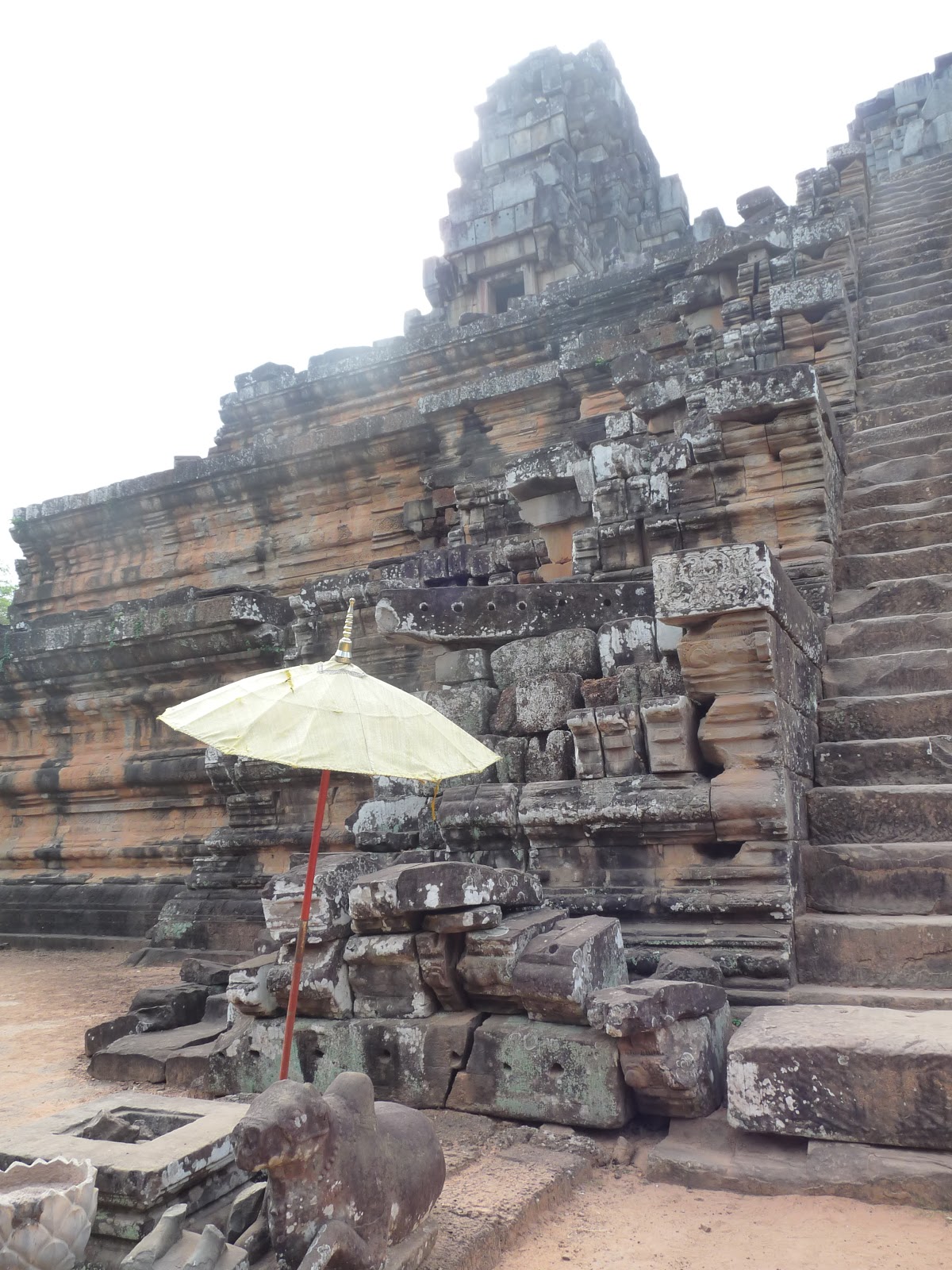
The city complex also contains the royal palace, elephant and lion terraces. After walking around, tuk-tuk dropped me at Ta Keo. It is another pyramid like temple. Though there are many shiva lingas are seen in different temples, here they preserved a Nandhi (a bull vehicle of Shiva) though it is kept at a side.
Here is a scene from Ramayana with Rama and Lakshmana
Here is a scene from Mahabharatha with Bishmar on the bed of arrows
The city complex also contains the royal palace, elephant and lion terraces. After walking around, tuk-tuk dropped me at Ta Keo. It is another pyramid like temple. Though there are many shiva lingas are seen in different temples, here they preserved a Nandhi (a bull vehicle of Shiva) though it is kept at a side.
Thursday, March 8, 2012
Travel 005 : Cambodia : 23 Dec : Bayon
Leaving from the Angkor Wat temple, we entered into the city of Angkor Thom. Passing through one of the entrances into the city, the first building that is at the end of the road is Bayon. Bayon is the temple with giant faces at every side of every tower that can be possibly built within. Bayon is also built like a pyramid structure surging upwards as we go toward the center. the most striking fact is that at every terrace, short towers that raises, contains faces at its four sides. Standing at one terrace, one can come very close to staring at the face.
As a trace of Hindu religion, there are some Lingams still left at one of the wings. I spent more than three hours in the Angkor Wat and so when I came out of Bayon, it was almost 5pm. As most of the buildings are closed at 5pm, I decided to stop for today and return to the Siem Reap city.
On the way back, stopped at the entrance of the Angkor Thom city (that I passed through before). At every possible bridge, walkway throughout Angkor complex, it is common to see the Naga at both sides pulled by Deva / Asuras. This entrance as well has the scene in front.
With these, I returned to Siem Reap on the tuk-tuk, paid the day's charge (8 USD). By this time, Hong became a good friend and so we agreed that he will come back at 8pm with only his bike (without the tuk-tuk carriage) and we can go look at some of the night-life scene. It really helps to have a local-language speaking friend with you to visit such places. I was fully exhausted with all the walking, climbing (and the hot sun). Took a shower, walked around the night markets (interesting that there are many street markets in the area and all of them call themselves as some night market), and had a good Indian dinner. The journey continues with more temples tomorrow.
As a trace of Hindu religion, there are some Lingams still left at one of the wings. I spent more than three hours in the Angkor Wat and so when I came out of Bayon, it was almost 5pm. As most of the buildings are closed at 5pm, I decided to stop for today and return to the Siem Reap city.
On the way back, stopped at the entrance of the Angkor Thom city (that I passed through before). At every possible bridge, walkway throughout Angkor complex, it is common to see the Naga at both sides pulled by Deva / Asuras. This entrance as well has the scene in front.
With these, I returned to Siem Reap on the tuk-tuk, paid the day's charge (8 USD). By this time, Hong became a good friend and so we agreed that he will come back at 8pm with only his bike (without the tuk-tuk carriage) and we can go look at some of the night-life scene. It really helps to have a local-language speaking friend with you to visit such places. I was fully exhausted with all the walking, climbing (and the hot sun). Took a shower, walked around the night markets (interesting that there are many street markets in the area and all of them call themselves as some night market), and had a good Indian dinner. The journey continues with more temples tomorrow.
Subscribe to:
Posts (Atom)